Interview with Prof. José M. Azorín – 8th European Congress on Neurorehabilitation in conjunction with the 20th Congress of the Society for the Study of Neuroprotection and Neuroplasticity
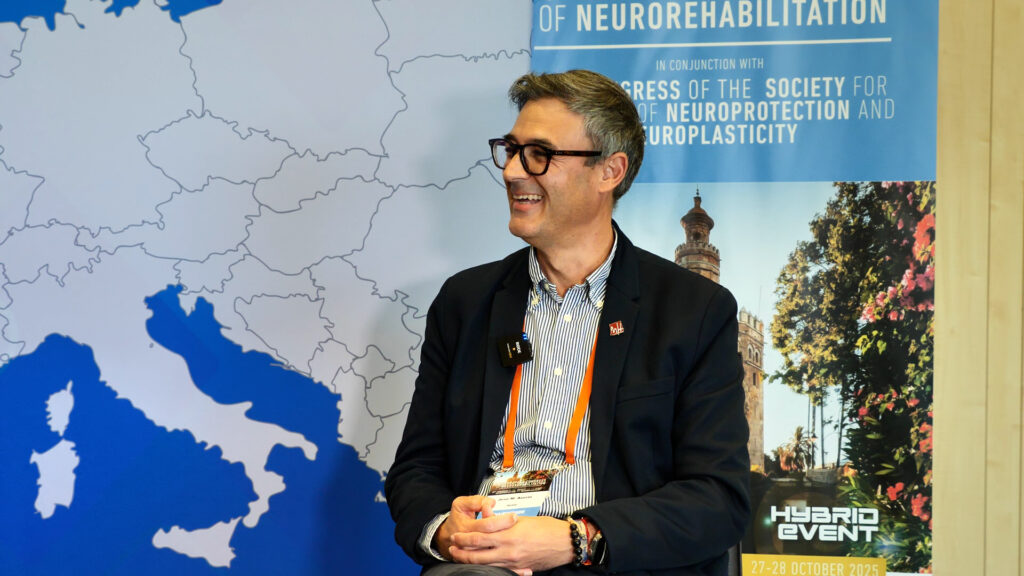
Interviewee: Prof. José M. Azorín
Interviewer: Ms. Stefana-Andrada Dobran
The 8th European Congress on Neurorehabilitation, in conjunction with the 20th Congress of the Society for the Study of Neuroprotection and Neuroplasticity, was held on 27–28 October 2025 in Torremolinos, Spain.
The landmark event highlighted innovations that are actively reshaping neurorehabilitation, including:
Brain–Computer Interfaces: Advancing from theoretical concepts to real-world clinical applications for functional restoration.
AI, Virtual Reality, and Robotics: Enhancing rehabilitation through more precise, personalised, and adaptive treatment protocols.
Advanced Pharmacological Therapies: Developing agents that actively support and protect neuroplasticity.
Multidisciplinary Collaboration: Emphasising that the most impactful innovations emerge at the intersection of multiple specialties.
Professor José M. Azorín is a prominent researcher in neurotechnology and Brain–Machine Interfaces (BMIs). He leads the Brain-Machine Interface Systems Lab and serves as Deputy Vice-Rector for Research at Miguel Hernández University of Elche (Spain), where he focuses on AI-based BMIs for controlling robotic exoskeletons in rehabilitation. He also directs the only European site of the BRAIN (Building Reliable Advances and Innovation in Neurotechnology) Center. He currently serves as President of AITADIS (Iberoamerican Society of Assistive Technologies).
In this interview, Professor José M. Azorín discusses the future of motor rehabilitation through Brain–Machine Interfaces (BMIs). He highlights the importance of collaboration between clinicians and technical experts, the potential of AI to improve decoding of brain signals, and the promise of non-invasive EEG-based systems. Professor Azorín also emphasizes the need for affordable, home-based rehabilitation technologies and explains the concept of BMIs as “symbiotic systems,” where both the human brain and the machine adapt to achieve effective control of assistive devices.
We kindly invite you to browse our Interview category: https://efnr.org/category/interviews/. You will surely find inspiring perspectives from world-renowned specialists in neurorehabilitation.